

Silicone Products
Silicone Products Silicone Sponge Profiles
What Are Silicone Sponge Profiles?
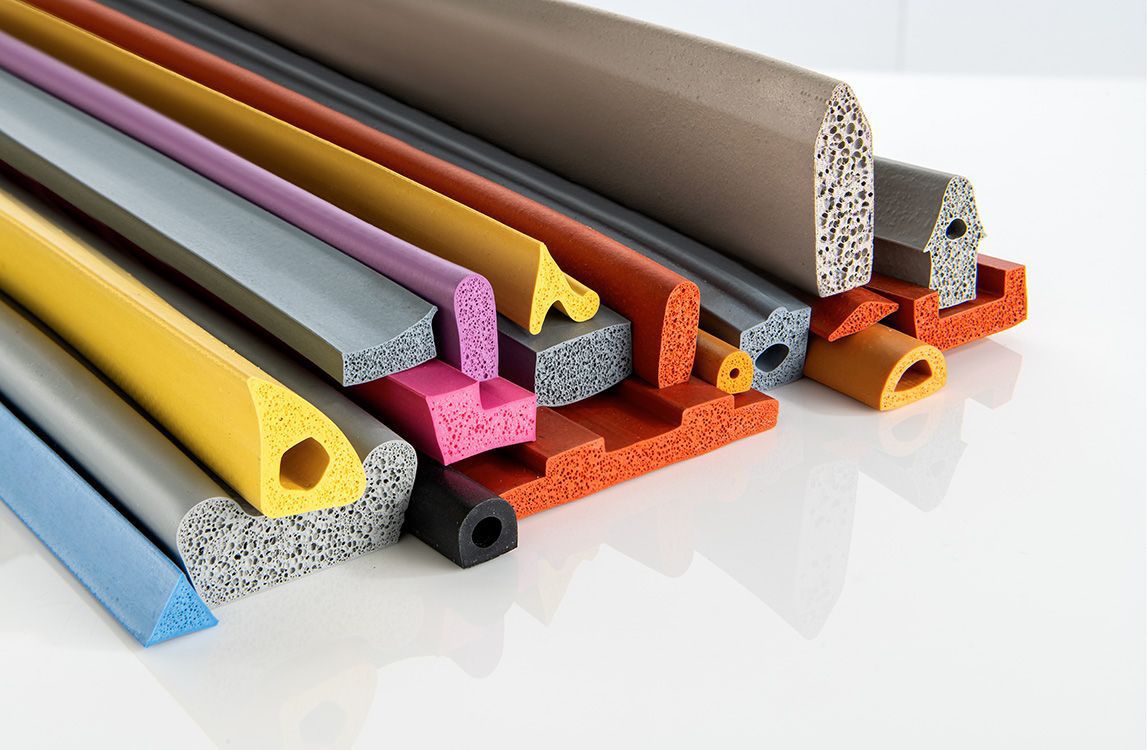
Silicone sponge profiles are custom closed-cell silicone extrusions manufactured in standard or complex cross-sectional shapes for sealing, gasketing, cushioning, insulation, and vibration isolation. Their cellular construction provides flexibility and compressibility, while the extruded profile geometry allows the seal to match specific application dimensions and installation requirements.
Bellofram Elastomers manufactures custom silicone sponge profiles in a wide range of shapes, densities, colors, and formulations. Standard options include rectangles, tubes, cords, U-profiles, P-profiles, double-P profiles, D-profiles, T-profiles, and E-profiles, while our in-house die-making capabilities support highly customized extrusion geometries.
Key Takeaways
- Silicone sponge profiles are closed-cell custom extrusions used for sealing, gasketing, cushioning, and insulation.
- Standard shapes include rectangles, tubes, cords, U-, P-, double-P-, D-, T-, and E-profiles.
- Bellofram Elastomers has in-house die-making capabilities for fully custom extrusion profiles.
- Available across ASTM D1056 densities from 2D1 soft through 2D5 extra firm.
- Designed for continuous temperatures from -85°F to +400°F.
- Flame-retardant options are available to meet UL 94 V-0 and UL HB requirements.
- NSF/ANSI 51 certified options using FDA-compliant materials are available.
- Qualified aerospace options include BMS 1-23 and BMS 1-60.
- A self-forming skin helps resist water absorption and environmental exposure.
- Custom colors are available.
Why Choose Closed-Cell Silicone Sponge Profiles?
Silicone sponge profiles combine the environmental durability of silicone with the compressibility of a closed-cell cellular material.
Unlike a simple round cord, profile extrusions can be engineered with complex geometry to create specific sealing surfaces, retention features, channels, bulbs, or contact points. This makes custom silicone sponge extrusion especially useful when a standard sealing shape cannot provide the required fit, compression, or installation method.
| BENEFIT | WHY IT MATTERS |
|---|---|
| Custom Profile Geometry | Allows the extrusion shape to match specific sealing surfaces, gaps, channels, and installation requirements. |
| Closed-Cell Construction | Provides compressibility while helping resist water absorption and environmental exposure. |
| Broad Density Range | Materials are available from soft ASTM D1056 2D1 through extra-firm ASTM D1056 2D5 for different compression requirements. |
| Wide Temperature Range | Maintains performance across continuous temperatures from -85°F to +400°F. |
| Self-Forming Skin | The extrusion process creates an exterior skin that improves resistance to moisture and environmental exposure. |
| Industry-Specific Formulations | Flame-retardant, NSF/ANSI 51, FDA-compliant, and aerospace-qualified material options are available. |
| Custom Colors and Sizes | Profiles can be tailored to functional, identification, branding, or aesthetic requirements. |
Available Silicone Sponge Profile Shapes
Bellofram Elastomers manufactures both standard and fully custom silicone sponge extrusion shapes. Our in-house die-making capabilities allow profile geometry to be tailored to specific sealing and gasketing requirements.
| PROFILE TYPE | TYPICAL USE |
|---|---|
| Rectangles | Flat compression sealing, cushioning, and gap filling. |
| Tubing | Hollow round sealing where additional compression and flexibility are required. |
| Cords | Simple round sealing, gasketing, and gap filling. |
| U-Profiles | Edge protection, channel sealing, and panel applications. |
| P-Profiles | Compression sealing where a bulb and attachment section are needed. |
| Double-P Profiles | Applications requiring multiple sealing contact points. |
| D-Profiles | Door, enclosure, and panel sealing. |
| T-Profiles | Retention, edge sealing, and custom mounting configurations. |
| E-Profiles | Multi-contact sealing and complex gasketing applications. |
| Custom Profiles | Designed around customer-specific geometry, compression, and installation requirements. |
Silicone Sponge Density and Compression Options
Bellofram Elastomers uses proprietary in-house silicone mixing to manufacture sponge profiles across the full ASTM D1056 density range.
| ASTM D1056 CLASSIFICATION | GENERAL DENSITY | TYPICAL USE |
|---|---|---|
| 2D1 | Soft | Low closure-force sealing and highly compressible applications. |
| 2D2 | Medium-Soft | Flexible sealing requiring slightly greater compression resistance. |
| 2D3 | Medium-Firm | General-purpose sealing and gasketing applications. |
| 2D4 | Firm | Applications requiring greater compression force and structural support. |
| 2D5 | Extra Firm | Heavy-duty sealing where higher compression resistance is required. |
This broad density range allows the profile to be tailored to closure force, compression, sealing pressure, and durability requirements.
Standards and Specialty Silicone Sponge Profiles
Bellofram Elastomers offers custom silicone sponge profiles for applications with specific flammability, food-contact, medical, and aerospace requirements.
| OPTIONS | TYPICAL APPLICATION |
|---|---|
| UL 94 V-0 | Flame-sensitive applications requiring enhanced vertical-burn performance. |
| UL HB | Applications requiring horizontal-burn flammability performance. |
| NSF / ANSI 51 | Food and beverage equipment requiring appropriate certified and FDA compliant materials. |
| BMS 1-23 / BMS 1-60 | Aerospace applications requiring Boeing-qualified closed-cell silicone sponge. |
| Custom Formulations | Application-specific silicone sponge compounds tailored to mechanical, environmental, and regulatory requirements. |
Silicone Sponge Profiles vs. Solid Silicone Profiles
The primary difference between silicone sponge profiles and solid silicone profiles is material construction. Silicone sponge profiles contain a closed-cell structure that makes them lighter and more compressible, while solid profiles provide denser, firmer rubber construction.
| FEATURE | SILICONE SPONGE PROFILES | SOLID SILICONE PROFILES |
|---|---|---|
| Construction | Closed-cell silicone sponge. | Dense, non-cellular silicone rubber. |
| Density | Lighter-weight profile construction. | Denser and heavier, solid elastomer construction. |
| Compression | Highly compressible and suited for lower closure-force sealing. | Firmer and less compressible, providing greater sealing force and mechanical stability. |
| Gap Filling | Well suited for uneven gaps and surfaces requiring greater conformability. | Best suited where a firm, dimensionally stable profile is required. |
| Typical Priority | Compression sealing, cushioning, environmental protection, and low closure force. | Mechanical durability, dense sealing, firmness, and dimensional stability. |
For applications requiring dense, rubber custom extrusion profiles, explore our Silicone Profiles.
Common Applications for Silicone Sponge Profiles
Custom silicone sponge profiles are used where a specific cross-sectional shape is needed to provide reliable sealing, cushioning, insulation, or environmental protection.
| APPLICATION | HOW SILICONE SPONGE PROFILES HELP |
|---|---|
| Doors and Hatches | Custom profile geometry creates compression seals around openings and irregular surfaces. |
| Electrical Enclosures | Helps protect sensitive components from water, humidity, dust, and environmental exposure. |
| Industrial Equipment | Provides gasketing, cushioning, vibration isolation, and environmental sealing. |
| HVAC Systems | Supports sealing around panels, doors, ducting, and air-handling equipment. |
| Food and Beverage Equipment | NSF/ANSI 51 and FDA-compliant material options support applicable regulated environments. |
| Aerospace | BMS-qualified material options support demanding sealing applications requiring documented material performance. |
| Transportation | Provides lightweight environmental sealing and vibration isolation around panels, doors, and equipment. |
| Outdoor Equipment | Silicone construction and self-forming skin support long-term resistance to moisture and weather exposure. |
Custom Silicone Sponge Extrusion Profiles
When a standard extrusion shape does not meet the application’s requirements, Bellofram Elastomers can develop a custom silicone sponge profile around the required geometry.
Our in-house die-making capabilities allow profile features to be engineered for:
- Compression sealing
- Retention and mounting
- Edge protection
- Multiple sealing contact points
- Irregular mating surfaces
- Large or complex gaps
- Cushioning and vibration control
- Application-specific dimensional requirements
Custom colors are also available, allowing profile extrusions to support identification, assembly, branding, or aesthetic requirements.
When Should You Choose a Silicone Sponge Profile?
A silicone sponge profile may be the right choice when the application requires more than a basic cord, tube, or rectangular extrusion.
Silicone sponge profiles may be ideal when:
- A custom cross-sectional shape is required.
- Low closure force and high compressibility are important.
- The profile must fit an irregular or complex sealing surface.
- Environmental moisture resistance is required.
- Operating temperatures range from -85°F to +400°F.
- A specific ASTM D1056 density is required.
- UL 94 V-0 or UL HB flame performance is needed.
- NSF/ANSI 51 or FDA-compliant material is required.
- BMS 1-23 or BMS 1-60 aerospace qualification is required.
- A custom color or profile geometry is needed.
Why Choose Bellofram Elastomers for Silicone Sponge Profiles?
Bellofram Elastomers combines in-house material compounding, extrusion, and die-making capabilities to provide standard and custom silicone sponge profiles from a single U.S.-based manufacturer.
Bellofram Elastomers offers:
- Standard and fully custom profile geometries.
- In-house die making.
- ASTM D1056 2D1 through 2D5 density options.
- Temperature capability from -85°F to +400°F.
- UL 94 V-0 and UL HB flame-retardant formulations.
- NSF/ANSI 51 certified options using FDA-compliant materials.
- BMS 1-23 and BMS 1-60 aerospace-qualified materials.
- Self-forming exterior skin for improved environmental resistance.
- Custom color options.
- U.S.-based manufacturing and technical support.
Frequently Asked Questions About Silicone Sponge Profiles
What is a silicone sponge profile?
A silicone sponge profile is a closed-cell silicone extrusion manufactured in a specific cross-sectional shape for sealing, gasketing, cushioning, insulation, or vibration-isolation applications.
What shapes can silicone sponge profiles be made in?
Bellofram Elastomers manufactures rectangles, tubes, cords, U-profiles, P-profiles, double-P profiles, D-profiles, T-profiles, E-profiles, and fully custom extrusion shapes.
Can Bellofram Elastomers make custom silicone sponge profiles?
Yes. Bellofram Elastomers has in-house die-making capabilities that allow custom silicone sponge extrusion profiles to be developed around customer-specific geometry, compression, and installation requirements.
What ASTM D1056 densities are available?
Bellofram Elastomers can manufacture silicone sponge profiles across ASTM D1056 classifications from 2D1 soft density through 2D5 extra-firm density.
What temperature range can silicone sponge profiles withstand?
Bellofram Elastomers silicone sponge profiles are designed for continuous operating temperatures from -85°F to +400°F.
Are flame-retardant silicone sponge profiles available?
Yes. Flame-retardant silicone sponge profiles are available in multiple densities, including formulations designed to meet UL 94 V-0 and UL HB requirements.
Are food-grade silicone sponge profiles available?
Yes. Bellofram Elastomers offers NSF/ANSI 51 certified silicone sponge extrusion options manufactured with FDA-compliant materials for applicable food and beverage applications.
Does Bellofram offer aerospace-qualified silicone sponge profiles?
Yes. Bellofram Elastomers is a qualified supplier of BMS 1-23 and BMS 1-60 closed-cell silicone sponge extrusion products for aerospace applications.
What is the difference between silicone sponge profiles and solid silicone profiles?
Silicone sponge profiles contain a closed-cell structure that makes them lighter and more compressible, while solid silicone profiles are dense and non-cellular. Sponge profiles are often selected for lower closure-force sealing and cushioning, while solid profiles provide greater firmness and mechanical durability.
Do silicone sponge profiles resist water absorption?
Bellofram Elastomers silicone sponge profiles develop a self-forming exterior skin during extrusion that helps improve resistance to water absorption and environmental exposure.
Can silicone sponge profiles be made in custom colors?
Yes. Bellofram Elastomers can manufacture silicone sponge extrusion profiles in custom colors to meet functional, branding, identification, or aesthetic requirements.
Are Bellofram Elastomers silicone sponge profiles made in the USA?
Bellofram Elastomers manufactures custom silicone sponge extrusion products at its U.S. facility in Newell, West Virginia.
Your Satisfaction is Our Focus!
Thank you for completing this form. Your interest in our products & services is highly valued, and we're excited to be considered for your needs. Rest assured, we will carefully review the information provided to offer a tailored solution. Our experts will work diligently to ensure you receive a timely and accurate quote. Should you have any questions or need further assistance, please feel free to contact us. We eagerly await the opportunity to serve you.